

When XDR Partners began, a single page was enough. We were a focused consultancy, and one clean page told people who we were and how to reach us.
But we’ve changed. XDR is now a holdCo that brings businesses together, with six disciplines under one roof: M&A, recruitment, fractional C-suite, management consulting, accountancy consulting and AI implementation. More skills are on the way. A single page could no longer explain any of that, so we rebuilt the site.
What was wrong with one page
A one-page site has a ceiling, and we had hit it.
- Six services don’t fit on one screen. Each discipline deserves its own explanation, not a line in a list.
- A group needs a structure. People should be able to see how the group, the team and the services connect.
- There was nowhere to show our thinking. No blog and no case studies meant no proof of what we know or what we’ve delivered.
- Updating it was a chore. Any change meant touching code, so the site went stale.
What we built
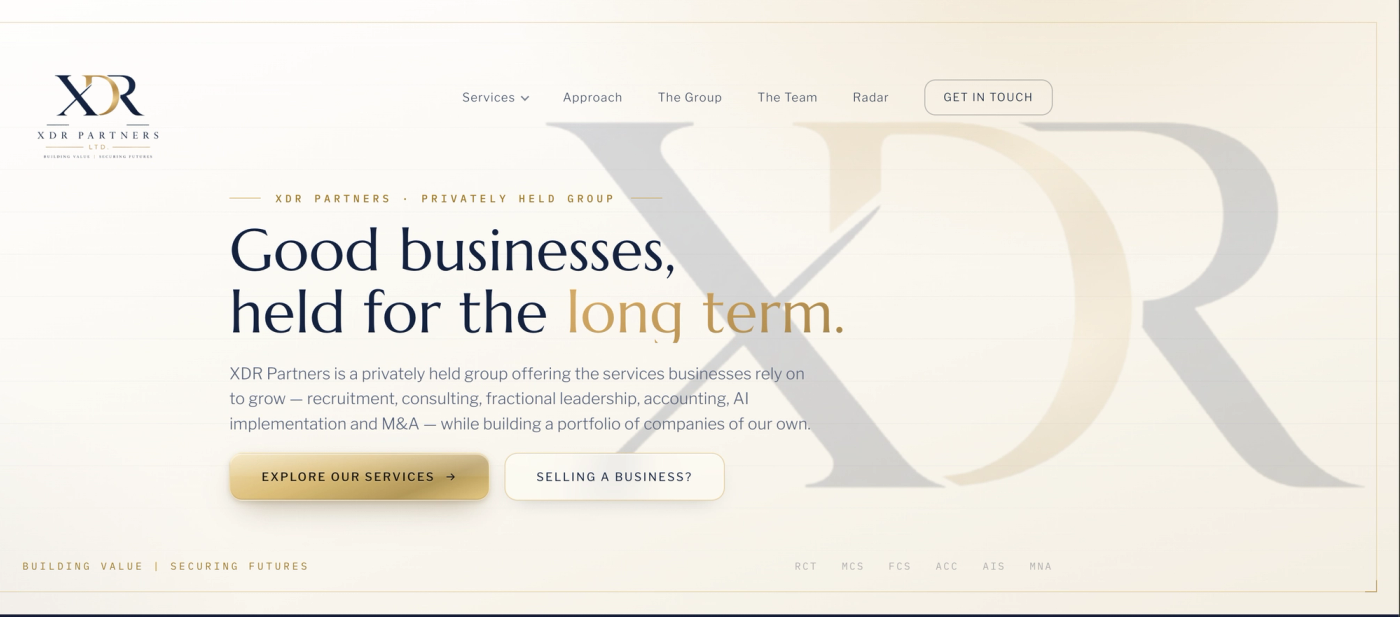
The one page became a proper multi-level site. There are dedicated pages for Services, Approach, The Group, The Team and Radar, along with new Insights and Case studies sections.
We also wanted it to feel designed, not just organised. A few of the decisions:
- Team profiles that open in place. Each team member has a card that opens a glass-style pop-up with their bio. Visitors get the detail without leaving the page or losing their place.
- One pattern across the site. Blog posts and case studies use the same cards and pop-ups. Once you’ve used the Team page, you already know how the rest works.
- Navy and gold throughout. The XDR palette runs through the cards, headers and watermark graphics, so every page looks like it belongs to us.
- Real division names on the cards. Each card shows which part of the group it belongs to, so a visitor sees how the business fits together.
The part you can’t see
The most important change is behind the scenes. We connected a content management system to the site, so we can write and publish without a developer.
You write in a simple editor and press Publish. The website then rebuilds itself and the new page goes live within a minute or two. Each post and case study gets its own address, and the sitemap updates automatically, which helps search engines find the new pages.
The site’s code is stored in GitHub and hosted on Netlify. Every change is tracked and any version can be rolled back, so we can improve the site without worrying about breaking it.
Why it matters to us
We advise businesses on how to run and grow, and increasingly on how to use AI and automation to do it. It would be odd to give that advice and then run a website that was hard to change.
Rebuilding our own site was a chance to apply the same approach we take with clients: work out what the business actually needs, build it properly to the brand, and leave the team able to run it themselves.